
Before you drop off your clothes and assume they'll be ready by the next day, read this. Different alterations have genuinely specific timelines, and showing up with unrealistic expectations doesn't help either you or your tailor. A hem and a shoulder adjustment are not the same job.
Understanding the difference means you plan better, stress less, and get back a garment that was altered properly rather than rushed. Here's what you need to know.
Typical turnaround: 3 to 5 business days
Hems are the most requested alteration in any tailor’s shop, and also the most misunderstood in terms of timing. A trouser hem on a standard fabric sits at the faster end of that range.
A circular skirt or flared dress hem can run two to three times the length of a straight hem, which means considerably more cutting, folding, and stitching. Formal gowns with layered fabric or lining can push the timeline to a full week or beyond.
Structured garments often benefit from a second fitting after the initial alteration. A hem is pinned during the first appointment based on how the garment sits on your body at that moment. What determines whether the finished hem is actually correct is how the garment hangs when you stand naturally, in the shoes you plan to wear. Take those shoes to your alteration appointment.
Typical turnaround: 5 to 7 business days
Taking in or letting out a waist is one of the most technically demanding standard alterations. It doesn’t just affect the waistband. It changes how the fabric sits across the seat, how the side seams hang, and, in some garments, the positions of pockets and belt loops.
Letting out a seam adds complexity. It can only be done if there’s sufficient seam allowance in the original construction, and not all garments have it. This is why an in-person assessment matters before booking this type of work.
Typical turnaround: 3 to 7 business days, depending on zipper type
A standard exposed zipper replacement on a jacket or pair of trousers sits at the lower end of that range. An invisible zipper, the type used in most formal dresses and structured skirts, is a different job entirely. The surrounding fabric has to be opened, the original stitching removed without damaging the seam, the new zipper positioned precisely so it sits flat and concealed when closed, and the seam reconstructed around it.
On a lined dress, the lining also needs to be reattached correctly around the new closure. Specialty zippers on designer garments can extend the timeline further because sourcing the right replacement takes time. A zipper of the wrong weight or finish looks wrong on a quality garment, even when it works.
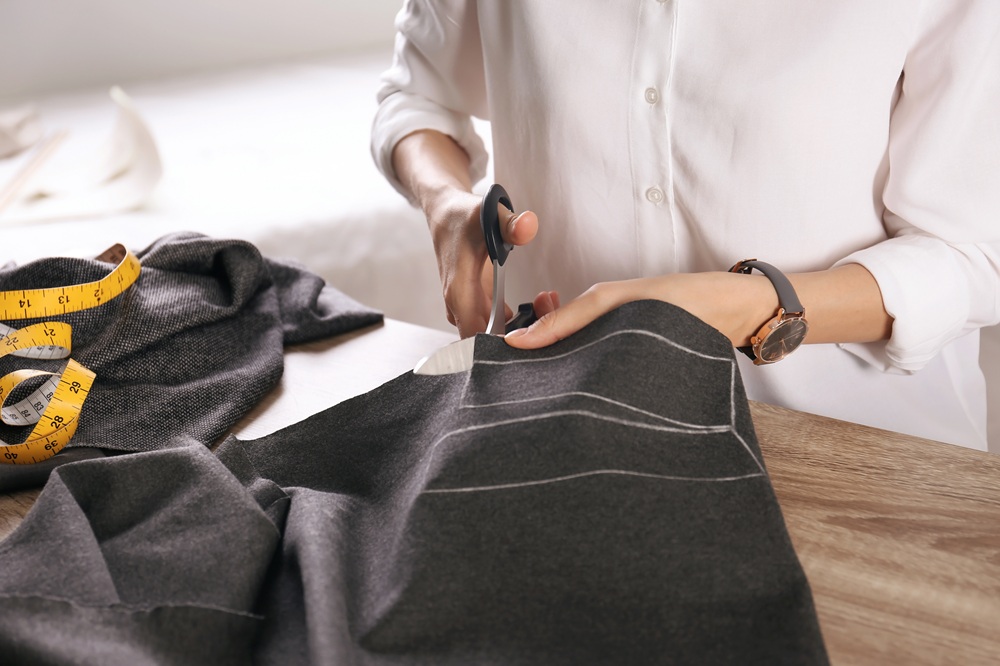
Typical turnaround: 5 to 14 business days, depending on garment type
A sleeve is set into the garment at a specific angle, with a deliberate amount of ease built in, buttons or vents at the cuff in many cases, and in a lined jacket, a separate lining sleeve underneath. Shortening a suit jacket sleeve is one of the most involved standard alterations a tailor performs.
On a quality jacket, the sleeve is shortened from the cuff end to preserve the set at the armhole, which means removing cuff stitching, repositioning buttons, reconstructing any working buttonholes, shortening the lining sleeve separately, and reassembling everything. On a jacket with four working cuff buttons, that process is time-consuming by design.
Shoulder adjustments are the most structurally significant alteration on a jacket or coat. Moving a shoulder seam shifts the collar, lapel, sleeve pitch, and chest fit simultaneously. This is one of the few alterations where a tailor may advise against proceeding if the required adjustment is significant.
If a shoulder adjustment is being considered on a high-value garment, book a consultation before committing to the work. A good tailor will tell you exactly what’s achievable before anything is cut.
Rush turnaround is realistic for simpler alterations on garments that don’t require a second fitting. A straightforward trouser hem, a basic side seam adjustment, or a standard zipper replacement can sometimes be completed within one to two business days if capacity allows.
Structural alterations are a different matter. A jacket sleeve shortening with working buttonholes, a shoulder adjustment, or a formal gown hem cannot be compressed without compromising the result. A garment rushed through that process often shows it, and not always immediately. The problem appears the first time you wear it properly.
Seasonal demand is the other constraint worth knowing about. In the weeks before wedding season, formal event season, and major holidays, most alteration shops are at full capacity. Rush requests during those periods are either declined or carry a premium price. Taking in garments six to eight weeks before an important occasion is the most reliable way to get the result you need without settling for what can be done quickly.
The best time to take in an alteration is well before you need it. A tailor working without a deadline produces better work, and you’ll have room to request adjustments if the first fitting isn’t exactly right.
When you understand how long common alterations take, planning ahead becomes hassle free rather than stressful. For over 20 years, Elite Cleaners has proudly served the communities of Fayetteville, Johnson, and Springdale, handling everything from simple hems to structural tailoring that genuinely improves how clothing fits and feels. We carefully assess every alteration job before confirming a timeline, so there are no surprises when you come to collect your item.
We also offer convenient, FREE Pickup and Delivery Service throughout Northwest Arkansas, so maintaining a well-fitting wardrobe doesn’t have to disrupt your schedule. If you have an upcoming event or a garment that’s been waiting too long for attention, get in touch. We’ll tell you exactly what the alteration involves, how long it realistically takes, and if a rush option is available for your specific job.
Call: (479) 575-9499
Serving:North College Avenue Fayetteville, North Crossover Road Fayetteville, Rogers, and Springdale