
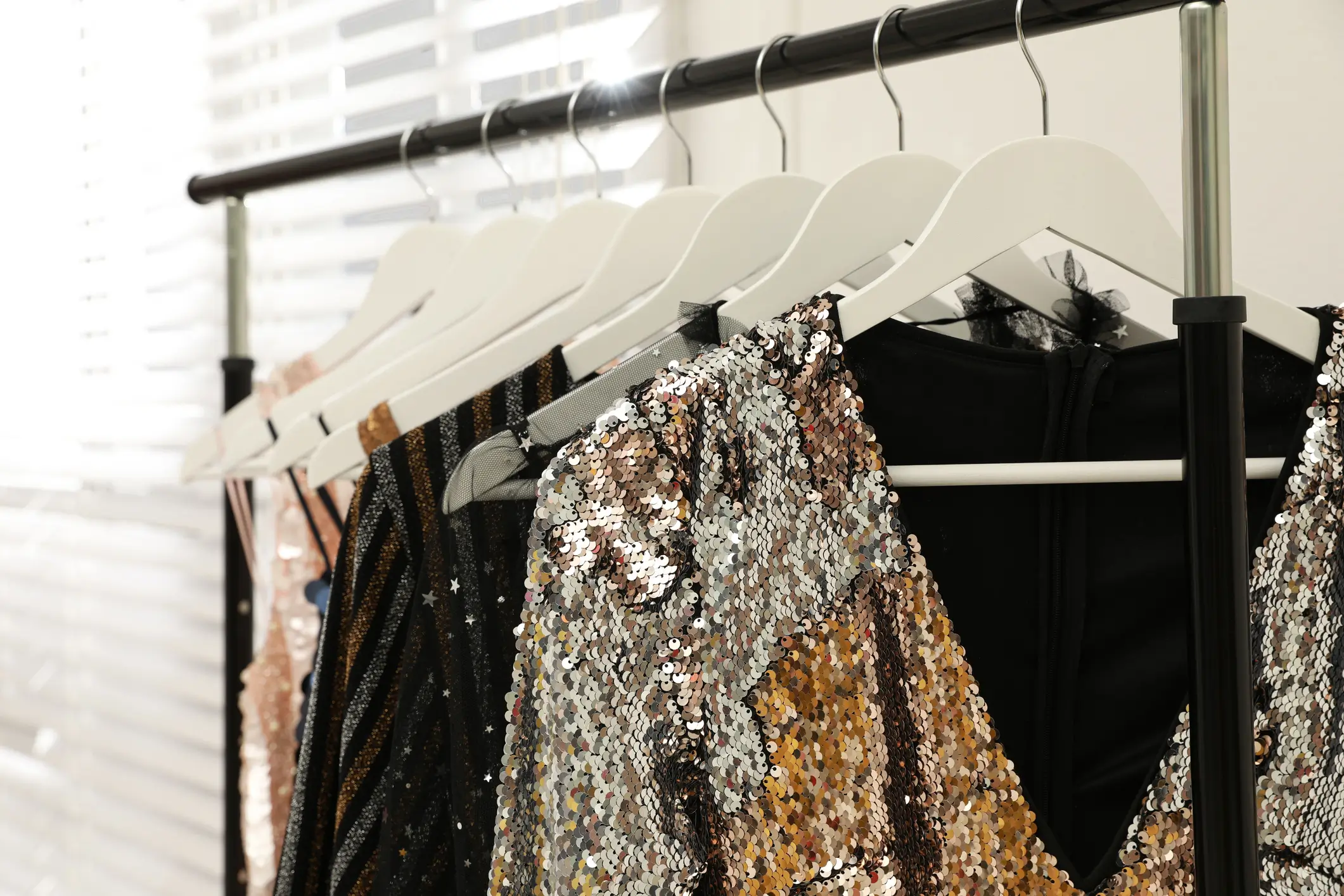
Nothing about dry cleaning is inherently unsafe for beads or sequins, which is exactly why it's easy to assume any cleaner can handle them the same way. They can't. A dress like this needs individual inspection, hand-finishing where the embellishment calls for it, and more time on the schedule than a standard load.
Hand it to a shop that doesn't make that adjustment, and the risk shows up fast. Spotting that difference yourself is the purpose of the rest of this guide.
Beading and sequins get lumped together as fragile, but they fail for different reasons, and that difference determines how careful you actually need to be. Beading is sewn on with thread, so the risk is abrasion: snagging, catching, or loosening from worn thread. That's a handling problem, solved with handling fixes such as protective netting or hand cleaning.
Sequins fail differently. Depending on the material, they can react to solvents much like plastic reacts to heat, softening, curling, or clouding, regardless of how carefully the garment is handled. That's a chemistry problem.
The shortcut: beading needs protection during cleaning. Sequins need testing before cleaning starts.
You can actually check this yourself before you ever hand over the dress. Turn the fabric over and look at the back of an embellished area.
Check more than one spot. It's common for a single dress to use sewn beading on the bodice and glued sequins along a trim or hem, so one quick look at one area doesn't tell you the whole story.
Not all sequins are made of the same plastic, and not all plastics react the same way to dry cleaning solvent. Acetate-based sequins are the classic problem. They can cloud, curl, or lose their shine when exposed to certain solvents, and that's a material issue, not a sign of a careless cleaner.
That's why testing beats promising. Touching a single hidden sequin with solvent before starting isn't overcaution. It's the one step that actually predicts how your dress will hold up.
A few materials worth knowing by name, so the term sequin stops feeling like one mystery category, include:
None of this is something you're expected to identify by material name at home. The point is simply that sequins aren't one fixed answer, which is exactly why a spot test on your specific dress matters more than a general rule.
Beyond sequins, a few other embellishment types show up constantly on formal and occasion wear, and each has its own soft spot.
None of these are reasons a dress can't be cleaned. They're reasons it needs a plan.
Before you even think about cleaning, a quick check tells you what state the dress is already in:
If you find loose spots before cleaning, mention them at drop-off. It tells the cleaner where to be most careful and sets honest expectations from the start.
Spot clean only is often a manufacturer's liability position, not a physical law. They tested one method and won't warrant anything else, even if another process would work fine on that garment.
That's not a reason to ignore it. It's genuine information telling you to proceed with caution. But it's not always the last word either. A shop that actually assesses your dress, its fabric, and how the embellishments are attached may reasonably reach a different, still-safe conclusion.
A careful cleaner starts with a thorough visual inspection of every embellished area, checking for anything that is already loose or missing. Next comes a test, usually on a single hidden sequin or bead, to see how that material reacts before the whole dress is at stake. Then they assess whether or not the attachment can even handle full processing.
The decision gets communicated to you directly: full processing, spot cleaning with hand-finishing, or a recommendation not to proceed. That last option matters most. A cleaner willing to say no is the one whose yes you can trust.
Walking in with a few direct questions puts you in control of the process:
A cleaner who answers these clearly, without brushing past them, is showing you exactly how they work.
Even with careful handling, some loss is possible on an older or heavily worn dress, simply because the original threads holding those embellishments have already weakened over time. This isn't a failure of the cleaning process. It's the reality of an aging garment.
A good cleaner will flag that risk before they start, not explain it away after the fact. That's a meaningful difference, and it's one you can listen for in how they talk about your dress at drop-off.
Bringing the loose pieces with you turns a disappointment into a fixable problem instead of a permanent loss.
Here's damage that has nothing to do with cleaning, and most people don't notice it until it's already done.
Heavy beading pulls on the bodice and shoulder seams when a dress hangs for months. Gravity does the rest, leaving the garment permanently stretched or misshapen in exactly the areas you care about most.
Store beaded dresses flat or laid over a padded surface instead of hanging them. Use breathable cotton instead of plastic, which traps moisture, and pad any folds with acid-free tissue to prevent creasing along the embellished sections.
A little care between wears protects the dress just as much as the cleaning.
Now that you can spot the difference between sewn beading and glued sequins, the real question is who's handling the dress next. That's where we come in.
At Elite Cleaners, embellished garments don't get the same dry cleaning process as everything else. We test a hidden sequin, check how your beading is attached, and tell you honestly what we'd recommend, whether that's full processing, hand-finishing, or holding off altogether. We've handled dry cleaning across Benton and Washington Counties long enough to know a five-minute assessment saves a lot of regret later.
For professional dry cleaning, stop by our Fayetteville or Springdale location with your dress, or reach out beforehand if you'd like to talk through your concerns.
Locations: Fayetteville and Springdale, AR
Fayetteville: +1 479 575 9499
Springdale: +1 479 977 7356
Email: info@elitecleanersnwa.com